

Viasat (NASDAQ: VSAT) closed fiscal 2026 with a quarter that largely met expectations. Revenue of $1.17 billion came in slightly above consensus, and non-GAAP EPS of $(0.02) was in line with a year ago. But the headline numbers understate the real shift underway. The company's record backlog of $4.1 billion, up 15% year-over-year, and a Defense & Advanced Technologies (DAT) segment that grew revenue 12% are the structural signals worth watching.
Q4 revenue rose 2% year-over-year to $1.17 billion, beating the $1.13 billion consensus estimate. GAAP net income swung to $58.8 million from a $(246.1 million) loss a year ago, driven by a $168 million gain on the sale of its Navarino equity investment and lower SG&A expenses. Adjusted EBITDA slipped 1% to $369.9 million, in line with the company's flat-to-slightly-up trajectory for the full year.
The Communication Services segment, which accounts for about 69% of total revenue, declined 2% year-over-year to $810 million. The culprit was a 24% drop in fixed services and other (FS&O) revenue, which fell to $132.7 million from $174 million. Aviation services grew 11% to $294 million, and government satcom services rose 5% to $205 million, but those gains weren't enough to offset the FS&O decline. Maritime services were essentially flat at $112.7 million. The segment's Adjusted EBITDA fell 6% to $287 million, reflecting higher R&D spending on multi-orbit initiatives and the FS&O drag.
This is where the backlog story becomes critical. Communication Services backlog grew 11% year-over-year to $2.9 billion, with FS&O and government satcom backlog up 19% and 18%, respectively. The FS&O revenue decline is expected — the company guided for a lower rate of decline in FY2027 — but the backlog suggests the segment's core mobility franchises are gaining traction. Commercial aviation aircraft in service reached 4,450, up 10% year-over-year, and the company's "Full, Fast, Free" Wi-Fi model with American Airlines and Southwest is scaling.
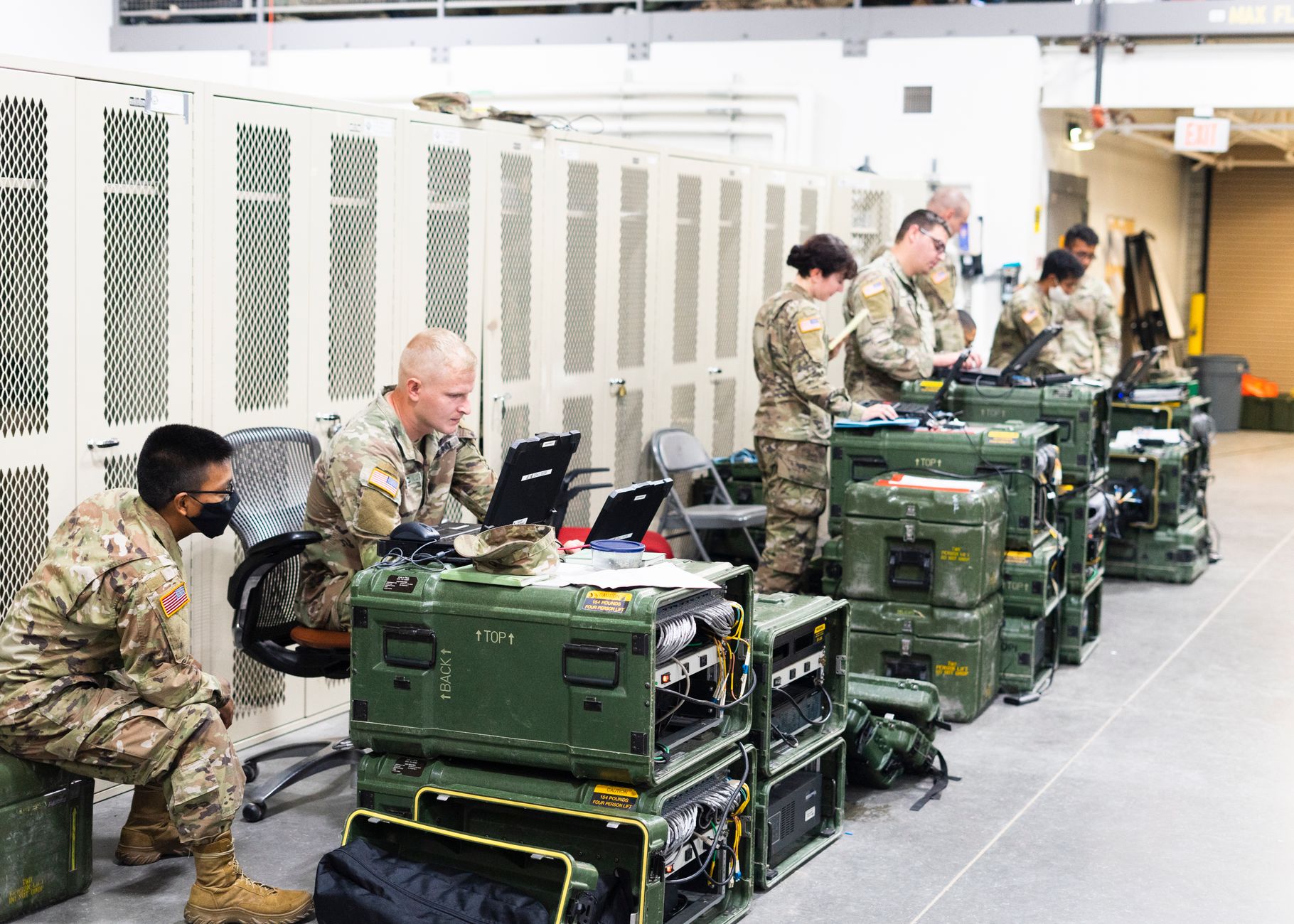
The Defense and Advanced Technologies segment was the standout. Revenue rose 12% to $361 million, driven by a 24% jump in information security and cyber defense products to $120 million and a 16% increase in space and mission systems products to $87 million. Segment Adjusted EBITDA grew 20% to $82.5 million, with operating profit up 29% to $62.2 million. DAT backlog hit a record $1.2 billion, up 23% year-over-year, with a book-to-bill ratio of 1.1x. The company noted record awards of $580 million in information security and cyber defense and over $1 billion in government satcom, including a multi-year $234 million SouthPAN award.
Free cash flow for the quarter was $24 million, down from $51 million a year ago, as capital expenditures rose 20% to $298 million. For the full year, free cash flow (excluding the $420 million Ligado lump sum payment) was $177 million, an improvement of $299 million year-over-year. Net debt declined to $4.8 billion from $5.6 billion a year ago, and the leverage ratio improved. The company ended the year with $2.9 billion in available liquidity.
Guidance for FY2027 calls for mid-single-digit revenue growth, with Adjusted EBITDA flat to up slightly. Communication Services is expected to grow low single digits, while DAT is expected to grow mid-teens. Capital expenditures are guided to $950 million to $1.0 billion, including $325 million for Inmarsat-related spending. Free cash flow is expected to be approximately $180 million, excluding the non-recurring Ligado payment.
The VS-3 F3 satellite launched on April 29, with service entry expected in August or September 2026. The company is also progressing on the Equatys L/S-band infrastructure initiative, which it expects to generate significant revenue from its role as technology provider. The PTS-G contract award, announced post-quarter, adds another layer to the DAT growth story.
The takeaway: Viasat's core Communication Services business is still digesting the FS&O decline, but the backlog and the DAT segment are building momentum. The FY2027 guidance implies a modest acceleration in the second half, driven by VS-3 service entry and DAT growth. The balance sheet is improving, and the company has generated positive free cash flow for five consecutive quarters. For a capital-intensive satellite operator, that's a meaningful milestone.